
Article contents
Desalination plant maintenance combines the agreed technical service with clear operating records and follow-up. This guide explains 8 service elements and practical ways to organise shift handovers, readings, fault reports and maintenance records for an RO installation.
Contents
Operation and Maintenance of RO Water Desalination Plants
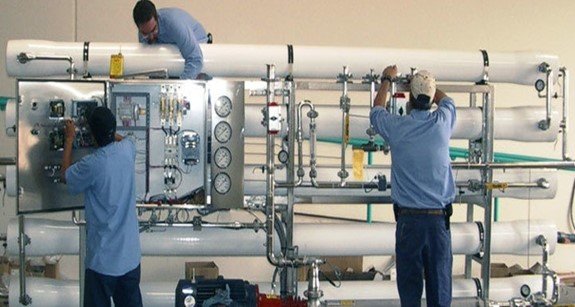
Water desalination plants are vital assets for industrial, commercial and service sectors. Building the plant is only the beginning; real success lies in operating efficiency and continuous maintenance.
Without professional operation and regular maintenance, a plant’s efficiency can drop by 20% to 40% in the first year alone, with a noticeable increase in energy consumption and a decline in the quality of the water produced.
This is why our operation and maintenance (O&M) service for water desalination plants matters. It is designed to ensure stable performance, achieve the highest operating efficiency and extend the service life of the equipment.
Why Is Operation and Maintenance of Water Desalination Plants Critical?
Water desalination plants are not static systems. They are dynamic systems that depend on a delicate balance between pressure, chemical treatment and the quality of the incoming water.
If operation and maintenance are neglected:
- RO membrane productivity drops by 10–15% within weeks
- Energy consumption rises by up to 25%
- The quality of the water produced deteriorates
- Sudden breakdowns disrupt operational continuity
With a professional operation and maintenance program:
- Membrane life extended to 3–5 years
- Stable water quality is maintained
- Fewer sudden breakdowns
- Improved energy and chemical consumption
Our Service at a Glance
We provide an on-demand operation and maintenance service for water desalination plants, giving the client complete peace of mind and confidence in the plant’s performance.
Core Service Components
| Service Item | Description | Frequency |
| Resident technician | On-site operation and maintenance expert | Continuous |
| Preventive maintenance | Periodic inspections and maintenance | Weekly/monthly |
| Full operation | Plant operated by our team | 3 weeks per month |
| Chemical cleaning | Chemical cleaning of the membranes | As needed |
| Filter replacement | Replacement of cartridge filter elements | Per schedule |
| Dosing adjustment | Adjusting chemical dosing rates | Periodic |
| Water analysis | Water quality tests | Regular |
| Reports | Preparing and delivering a comprehensive performance report | Monthly |
1) Providing a Resident Operation and Maintenance Technician
This is a key element in successful operation, and the role includes:
- Daily monitoring of plant performance
- Rapid intervention whenever a fault occurs
- Continuous monitoring of operating indicators
Benefit:
- Shorter downtime
- Stable operation
- Better technical decision-making
2) Preventive and Corrective Maintenance
Maintenance is not just about repairing breakdowns; it is a proactive way to preserve the plant’s efficiency.
Preventive maintenance includes:
- Inspecting and lubricating pumps
- Reviewing pressure vessels
- Inspecting valves and pipelines
- Verifying the integrity of the electrical systems
Corrective maintenance includes:
- Repairing faults when they occur
- Replacing damaged parts within the routine scope
- Addressing any drop in performance
Impact of regular maintenance:
| Indicator | Without Maintenance | With Maintenance |
| Breakdowns | High | Reduced by 50–70% |
| Equipment life | 3–5 years | 5–10 years |
| Efficiency | Deteriorating | Stable |
3) A Flexible, Well-Planned Operating Model
We offer a practical operating model that balances efficiency with reasonable cost.
How it works:
- Full plant operation by our team for 3 consecutive weeks each month
- Training one member of the client’s staff to supervise and follow up during the fourth week.
Advantages of this model:
- Lower operating costs
- Continuous technical supervision
- Flexibility in resource management
4) Chemical Cleaning of the Membranes
Reverse osmosis membranes are the heart of the plant, and over time they become exposed to fouling and deposits, such as:
- Salts (Scaling)
- Biological growth (Biofouling)
- Organic matter
What we provide:
- Carrying out CIP (Cleaning In Place) operations when needed
- Selecting the right chemicals according to the type of deposit
- Evaluating cleaning effectiveness after execution
Expected results:
| Indicator | Before Cleaning | After Cleaning |
| Productivity | 20–30% drop | Recovers to up to 95% |
| Differential pressure | High | Normal |
| Separation quality | Low | Improved |
5) Replacing Cartridge Filters
Filters play an important role in protecting the membranes from impurities.
Why they matter:
- Removing suspended solids
- Reducing the load on the membranes
- Maintaining stable pressure
Replacement policy:
- Based on differential pressure and operating hours
- Usually every 2 to 6 weeks
Result:
- Fewer breakdowns
- Longer membrane life
- Stable production
6) Adjusting Chemical Dosing
Chemical dosing rates are not fixed; they must be adjusted continuously.
The chemicals include:
- Antiscalants
- Chlorine or dechlorination agents
- pH adjusters
- Coagulants
What we do:
- Monitor dosing rates periodically
- Adjust them based on water analysis
- Prevent overdosing and underdosing
Impact:
- Scaling reduced by up to 90%
- Chemical consumption cut by 10–20%
- Improved membrane performance
7) Water Quality Analysis
Water quality is the true indicator of plant performance.
The analyses include:
- Total dissolved solids (TDS)
- pH level
- Conductivity
- Bacteriological analysis
- Hardness
Frequency:
- Daily field measurements
- Periodic laboratory analyses
Typical values:
| Indicator | Target Value |
| TDS | Less than 150 ppm |
| pH | 6.5 to 8.5 |
| Conductivity | Less than 500 µS/cm |
| Bacteria | Within safe limits |
8) Monthly Reports
We believe transparency is essential to the success of any service.
The report includes:
- Summary of plant performance
- Production volumes
- Energy and chemical consumption
- Maintenance work carried out
- Technical recommendations
Simplified sample:
| Item | Value |
| Monthly production | 3500 m³ |
| Recovery rate | 75% |
| Energy consumption | 3.8 kWh/m³ |
| Downtime rate | Less than 2% |
Service Terms
We are committed to delivering a clearly defined service through a formal contract that sets out every detail.
Contract duration:
- 12 months
Payment:
- The service fee is paid in advance at the start of each month
Warranty:
- We guarantee the quality of operation and maintenance throughout the contract term
Exclusions:
- Abnormal breakdowns, or those caused by external factors, are handled separately
- Spare parts outside the scope of routine maintenance are not included
Contracting:
- A detailed contract is signed covering:
- Technical scope
- Responsibilities
- Administrative terms
Summary
Operating and maintaining water desalination plants is not just a daily task; it is a long-term investment that requires expertise and close follow-up. With our operation and maintenance service for water desalination plants, you can rely on an integrated system that delivers stable performance, high quality and controlled costs.
If you are looking for a reliable partner to manage your plant efficiently and professionally, this service has been designed to fully meet your needs.
Contact Us Now
- Call us and get a free consultation
- Or message us on WhatsApp and request a free quote
- Or send your project details by email:

Baseline records for desalination plant maintenance
Collect the equipment list, approved layout, manuals, commissioning report and available water analysis before reviewing the maintenance programme. Identify the current version of each document and ask the supplier to provide anything missing. A desalination plant maintenance review is easier to interpret when the team knows what was installed, which changes were approved and which records describe the current operating arrangement.
Keep the names and responsibilities of the people who operate the plant, approve work and contact the supplier. Desalination plant maintenance records should remain accessible when staff change. Describe the intended use, working hours and known changes to the source water, distinguishing confirmed information from estimates. This provides context for the observations recorded during routine operation.
Shift handovers and desalination plant maintenance
Use a desalination plant maintenance handover record to explain the current plant condition, unresolved work and observations from the previous shift. Identify when readings were taken and whether the plant was operating normally at that time. Link any interruption or approved change to its report number so the next operator can follow the sequence rather than starting from a brief description without context.
At the beginning of a shift, review which items require monitoring or a decision from the responsible technician. Define who receives a report when an alarm, leak or quality concern appears. Record the response and outcome with the time of the action. Avoid relying on an undocumented conversation as the only record of a change affecting operation.
Operating logs for desalination plant maintenance
Build the recording sheet around the measurement points actually installed at the site. Include the point name, time, unit, reading, operator and relevant comments. Distinguish feed-water measurements from product-water measurements and do not enter a number without its unit. Consistent labels allow later reviewers to understand what was observed and to compare records from different operators.
If an instrument is unavailable or suspected to be unreliable, record the issue rather than entering an estimated value as a measured result. Keep calibration and replacement records with the equipment history. When a reading changes, the technician needs to know whether the operating conditions, measurement point or instrument changed before drawing a conclusion from the number.

Performance reviews in desalination plant maintenance
A change in measured output needs context. Record the available operating conditions and ask the responsible specialist to assess performance against an appropriate reference. Membrane manufacturers discuss normalising performance to account for operating influences; this is different from treating every change in measured flow as evidence that equipment has failed. Keep the relevant reference and review method documented.
Use the commissioning record or the reference agreed by the designer, and explain any limitations in the available data. If the project conditions change, review the comparison basis. Do not turn one low reading into an automatic cleaning or replacement instruction. Gather the observations, check the equipment documentation and let the responsible technician decide the next action.
Pretreatment records in desalination plant maintenance
Include the upstream treatment equipment in the approved monitoring plan. Record the checks and replacement work relevant to the installed components, linking observations to the main plant log. This gives the reviewer a connected history rather than separate records that make it difficult to see whether an upstream issue coincided with a change in the membrane system.
Ask the supplier to identify the checks and recording requirements for your actual arrangement. Do not copy the service schedule of an unrelated installation without reviewing it. Keep approved consumable descriptions and part numbers with replacement records, and document the approval of a substitute if the usual component is unavailable. The equipment history should show what was fitted and when.

Cleaning records in desalination plant maintenance
When a specialist approves cleaning, prepare the work record and the procedure applicable to the installed components. The technician should record the operation details and results required by the manufacturer. This article does not prescribe a general cleaning mixture or dose; the appropriate procedure depends on the equipment documentation, site conditions and the work authorised for that installation.
After the work, keep the findings with the reason for cleaning and the observations taken beforehand. Record follow-up recommendations and the person responsible for reviewing them. If the result differs from expectations, document it and request an assessment instead of repeating a process automatically. A clear history helps later visits consider the actual work and its outcome.
Spare parts for desalination plant maintenance
List recommended consumables and spares with their part numbers, descriptions and associated equipment. Record quantities, storage location and ordering arrangements, and follow the supplied storage instructions. A general commercial name is not always enough to identify a suitable replacement. Ask the supplier to confirm any alternative before it is used and retain the supporting documentation.
Link each issued part to the work order in which it was installed. Record the replacement date, reason and observations afterward. Repeated demand for a component should be reviewed in context by the responsible specialist rather than addressed only by buying a larger stock. Update the list when a replacement design or approved alternative changes the equipment configuration.
Fault reporting for desalination plant maintenance
A useful report identifies the plant and equipment, the time the symptom appeared and what the operator actually observed. Attach the available readings, alarm history and relevant work records. Describe the current operating state and actions already taken. Keep observations separate from an assumed diagnosis so the technician can assess the evidence and request the next checks.
Define the reporting route and who has authority to approve changes under the site procedure. Record instructions, their source, implementation and outcome. Operators should work within their responsibilities and the equipment instructions. If a visit is needed, send the requested information and agree readiness requirements before confirming attendance, so the technician arrives with an accurate understanding of the problem.
Work orders for desalination plant maintenance
Create a separate record for each maintenance activity, showing the reason, equipment, responsible person, approved work, parts used and inspection result. Link it to the fault report or planned task that created it. A reference number connects the technical notes, correspondence and associated expenses, helping the team trace an action without searching several unrelated records.
When closing the work order, state whether the equipment returned to service or still needs another action. List outstanding items and their owners, and obtain the review required by the site process. Closing a visit should not make unresolved work disappear. Carry remaining actions into a list that can be reviewed at the next shift or service meeting.
Monthly reviews of desalination plant maintenance
Identify the reporting period and any gaps in the data before presenting the results. Summarise production, interruptions, completed work and technical observations, referring to relevant work orders. Separate recorded facts, technical interpretation and proposed actions. This allows the client to see what was observed, what needs further analysis and what decision is being requested.
Review actions from the previous report and show their current status. Assign an owner, target date and completion check to each new action. Where records conflict, flag the discrepancy and request clarification from the source. A report should give the site team a practical next step and enough context to assess the effect during the following period.
Service scope for desalination plant maintenance
Review the service elements described above against the agreement for your project. Identify responsibilities for staffing, visits, parts, testing and documentation, and keep a clear list of included work and separately authorised activities. Preserve the written commercial terms and ask how they apply to the site rather than assuming that a general service description resolves every scope question.
Define how extra work is approved and how changes to operating hours, source water or intended use are reported. If the scope changes, document its effect on resources and the plan. Share the current agreement with the operator, supplier and contract coordinator so each party knows the reference used when requesting, performing and reviewing an activity.
Requesting a desalination plant maintenance proposal
Prepare the equipment identification, manuals, available water analysis, operating records and a description of the service required. Explain whether you need a maintenance-plan review, ongoing operating support or an assessment of a specific issue. Ask which information is sufficient for an initial review and which items require measurements or a visit before a project-specific scope can be agreed.
Use the contact options above or the ALPHA Environmental website to discuss your requirements. Identify missing information clearly and request the next steps. Keep the dated enquiry and supplier response with the project records, so that the proposal can be checked against the actual information supplied rather than assumptions made later.
Manufacturer reference
For the principles of operating records and membrane performance comparison, consult the DuPont FilmTec technical manual. Apply the documentation for the components installed at your site and the approved maintenance procedure.