

Article contents
Charitable desalination plants need a plan that continues beyond opening day. This guide covers 8 project steps: demand, source assessment, site selection, responsibilities, proposal comparison, operating funds, receiving and training, and monitoring and maintenance.
Contents
Charitable Desalination Plants – The Ideal Model for Charitable Work in Rural Villages and Mosques in Egypt

Introduction
Access to clean drinking water remains a daily challenge for a large number of rural villages and mosques in Egypt, especially remote villages and coastal areas. Despite the great efforts the state is making to develop water infrastructure, some villages still depend on highly saline well water or water delivery trucks, which negatively affects health and daily stability.
This is where charitable desalination plants stand out as one of the most sustainable and impactful models of charitable work, combining the meeting of basic human needs with the long-term concept of ongoing charity (Sadaqah Jariyah).
Water in Rural Egypt – Figures and Facts
To understand the importance of this type of project, it is necessary to take a realistic look at the water situation in rural villages:
- Per-capita water resources in Egypt are below 560 cubic meters per year, far below the global water poverty line (1000 m³).
- Many villages rely on highly saline groundwater that is not suitable for drinking without treatment.
- In many areas, water trucks arrive only twice a week.
- Many mosques in remote villages suffer from a shortage of the water needed for ablution and cleanliness.
These facts make water projects a top priority in charitable work in Egypt.
What Are Charitable Desalination Plants?
Charitable desalination plants are plants built with funding from donors, charities or community initiatives, with the aim of providing clean drinking water free of charge or at a nominal cost to the most needy groups.
These plants are especially suitable for:
- Rural areas with saline groundwater
- Mosques, prayer rooms and Islamic centers
- Coastal villages on the Mediterranean and Red Seas
- New residential communities in desert areas
These plants most often rely on reverse osmosis (RO) technology, which can remove up to 99% of salts, bacteria and contaminants.
Why Are Desalination Plants an Ideal Choice for Villages and Mosques?
- A continuous water source
Unlike seasonal water sources, desalination plants operate year-round, ensuring a stable water supply.
- Long-lasting charitable impact (Sadaqah Jariyah)
A well-managed desalination plant can serve the community for 10 to 20 years, making it one of the greatest forms of ongoing charity.
- Flexible production capacity
Plants can be designed according to the needs of each site:
- 5–10 m³/day: a small village or a single mosque
- 20–30 m³/day: larger villages or a cluster of mosques
- 50 m³/day and above: several villages, schools and health units
The Role of Mosques as Water Distribution Centers
In rural Egypt, the mosque is not only a place of worship; it is also a trusted community center, which makes it an ideal location for desalination projects.
Advantages of Building Desalination Plants Inside or Next to Mosques:
- Daily use of water for ablution and cleanliness
- Easy access to water for local residents
- Permanent community oversight of the plant
- A clearly visible charitable impact for donors
In many villages, water distribution points are set up next to the mosque, serving hundreds of families every day.
Health and Social Impact on Rural Villages
Charitable desalination plants make a real difference in residents’ lives, and the most notable results include:
- A 30–50% drop in water-related diseases
- A clear improvement in hygiene and public health
- Less reliance on buying or transporting water
- Saving up to 3 hours a day for each family that used to be wasted fetching water
This extra time translates directly into children’s education and improved household income.
The Main Components of Charitable Desalination Plants
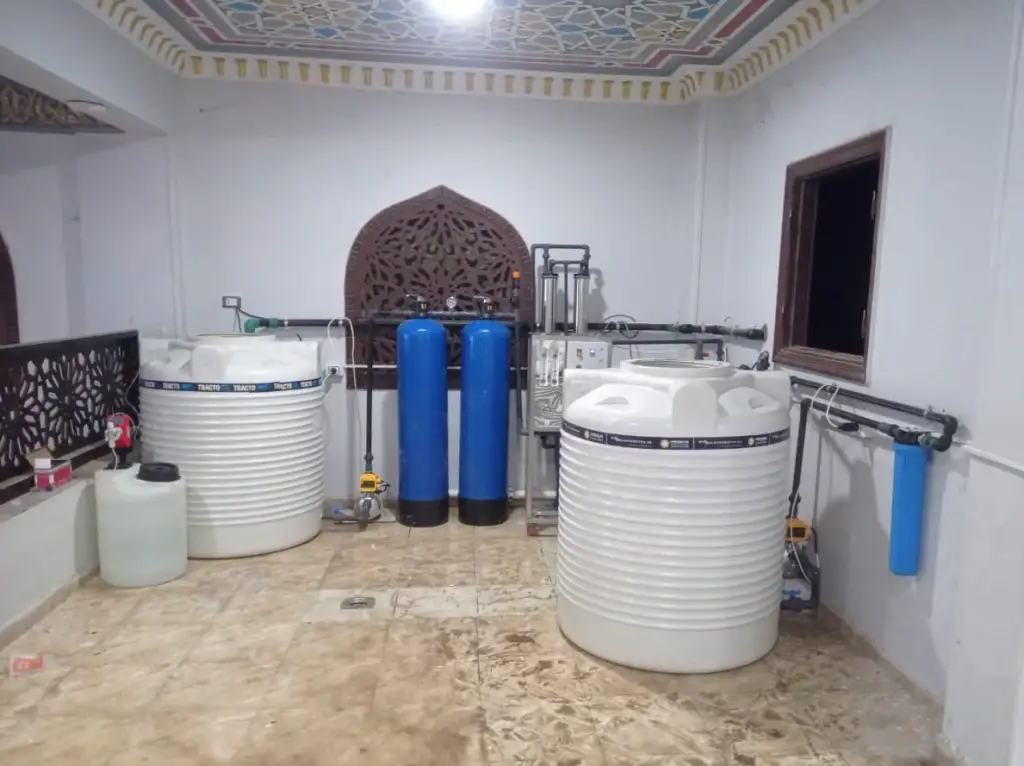
A typical plant serving villages or mosques consists of:
- A raw water source (usually a well)
- Filtration and pretreatment units
- High-pressure pumps
- Reverse osmosis (RO) membranes
- A disinfection and final treatment system
- Tanks and water distribution points
Expected Lifespan of the Main Components
| Component | Expected lifespan |
| RO membranes | 3–5 years |
| High-pressure pumps | 8–12 years |
| Control panels | More than 10 years |
| Tanks and civil works | More than 20 years |
Economic Efficiency and the Value of Donating
Some donors worry about operating costs, but reality confirms that modern charitable desalination plants have a reasonable operating cost.
Average breakdown of operating costs
| Cost item | Share |
| Electricity | 35–45% |
| Membrane replacement | 15–25% |
| Chemicals | 10–15% |
| Maintenance and labor | 15–20% |
Community Participation Is the Foundation of Sustainability
The success of any charitable project depends on involving the local community, which includes:
- Training a person from the village or the mosque attendant
- Simple operating systems with alarms
- A clear maintenance schedule
- Regular technical support from specialists
Projects with community participation achieve an uptime rate above 95%, compared with other projects that fail for lack of local follow-up.
Challenges and Realistic Solutions
Main current challenges:
- Initial construction costs
- The need for technical expertise
- Long-term maintenance
Practical solutions:
- Cooperating with companies specialized in water treatment such as Alpha®
- Using standard designs that can be expanded later
- Setting up a simple community fund for consumables
- Linking the project to the mosque to ensure its supervision and continuity
Why Is This the Most Suitable Model for Charitable Work in Egypt?
Compared with temporary aid, charitable desalination plants provide:
- A permanent water supply
- Clear operating costs
- The ability to expand in the future
- A lasting religious and social impact
Conclusion
Charitable desalination plants in rural villages and mosques in Egypt are among the most powerful and far-reaching forms of charitable work. They protect health, serve worship, support the stability of communities and give donors a continuing reward for many years.
Start Your Charitable Project with Alpha®
- Call us and get a free consultation
- Or message us on WhatsApp and request a free quote
- Or send your project details by email:
Defining demand for charitable desalination plants
Describe the area the project will serve and the need the organising group wants to address. Collect the expected distribution points, service hours and demand, distinguishing confirmed information from estimates requiring a site review. Do not choose equipment only from the available donation amount. Give the supplier the source, demand and operating plan so it can explain the basis of its recommendation.
Separate the expected number of beneficiaries from actual service that can be measured after startup. Identify who gathers and reviews the information with project management. When demand changes or a distribution point is added, discuss the effect on equipment, operation and support before approval. An existing installation should not be assumed to cover every future increase without a review of its agreed scope.
Source assessment for charitable desalination plants
Prepare the available water analysis with the sampling date and location, and explain source conditions and existing treatment. If suitable information is missing, ask the specialist which checks are needed before design selection. Appearance, taste or one dissolved-solids reading is not a complete basis for approving drinking-water use. Review the applicable requirements and assessment with the responsible technical parties.
Name the person who deals with the source and supplies information to the vendor. If availability or conditions may change, state that in the enquiry and identify what needs further study. Retain reports in the project folder and review new information against the original assumptions. This keeps the decision tied to the actual location rather than copying a different project without assessment.

Site planning for charitable desalination plants
Photograph the proposed equipment area, access route, connections and approach to the distribution location. Provide measurements and label approximate dimensions. Discuss the space needed for operation and maintenance with the supplier, and review access and supervision with the organisation responsible for the site. Confirm these arrangements before treating the location as ready for equipment delivery.
Allocate responsibility for power, feed water, tanks, drainage and any civil work required by the agreed proposal. Link preparation to a schedule with an owner for each task and a completion check. If the location changes or an obstruction appears, notify the designer before making an independent alteration. Keep the current drawing available to the people preparing and installing the equipment.
Management responsibilities for charitable desalination plants
Identify the organisation that will manage the project after supply is complete. Define the operator, maintenance contact, spending authority and person responsible for reports. The name of a campaign or charity does not by itself explain who makes daily decisions. Share contact details and the backup arrangement with the supplier and local team so a concern can reach the appropriate person.
Use a handover record when the operator or coordinator changes. Include equipment status, open work, documents, support contacts and available stock. Keep the file in a known location and identify who updates it. Continuity depends on knowledge, resources and oversight, so the operating arrangement should remain understandable after opening day instead of relying entirely on one individual.
Comparing proposals for charitable desalination plants
Send the same project brief to the suppliers and request equipment, service, exclusion and optional-item schedules. Compare scope before total price, asking about proposed output, site requirements and delivered documents. If a supplier recommends a different arrangement, request the reason and supporting assumptions. A difference should be understood in relation to the project rather than treated automatically as an advantage or disadvantage.
Separate the unit cost from transport, unloading, installation, commissioning, training and initial consumables. Identify client-supplied work and activities requiring a specialist, retaining dated answers. When requirements change, request a revised offer so the purchase does not proceed against a scope different from the one reviewed by the project team or accepted by the funder.
Operating funds for charitable desalination plants
Prepare an operating-cost plan alongside the construction budget. Ask for estimates tied to the proposed water source, output and working hours, explaining electricity, consumables, testing, service and staffing where applicable. Do not treat a percentage from another installation as a confirmed budget. List the assumptions and items requiring quotations or additional information before the plan can be approved.
Identify who provides recurring resources and how spending and consumable orders are reviewed. If funding arrives in stages, connect each stage to the agreed work and records. Discuss operation before equipment is purchased. Keep project expenses traceable and review the estimate when operating records become available, so the continuing plan reflects actual service rather than only the initial forecast.
Receiving and training for charitable desalination plants
Agree the readiness checklist, package-receiving responsibility and installation coordination with the supplier. Plan commissioning and use a handover record covering agreed checks, documents and open items. Identify who reviews delivery and follows up outstanding actions. Arrival of equipment or completion of a visit does not necessarily mean that every requirement in the project has been closed.
Train the people who will actually operate the installation using its equipment and instructions. Cover routine observations, shutdown, reporting and the limits of the operator role. Retain unanswered questions and the response. Make the current documents and support details available to the supervisor and backup operator, reviewing training needs when staff change rather than assuming that knowledge transfers automatically.
Monitoring arrangements for charitable desalination plants
Agree the monitoring and recording plan with the responsible specialist around the installed equipment, source and intended use. Small-supply guidance stresses risk management, monitoring and defined responsibilities. Selecting a treatment technology should be accompanied by an understandable operating arrangement in which the team knows what to observe, when to report and who reviews the result.
Use clear measurement-point names, recording the time, unit, reading and required comments. Retain test reports with their dates and sample identities and connect concerns to subsequent action. Show missing or conflicting information instead of silently replacing it with an estimate. Review the records with the technical team to decide which questions require checks, follow-up or a change to the approved plan.
Maintenance and spares for charitable desalination plants
Request a service schedule for the installed components and planned use, with consumable identifiers and ordering arrangements. Keep equipment manuals, warranty terms and support scope accessible, clarifying separately approved work or visits. Do not assume that parts with similar names are interchangeable. Ask the supplier to confirm an alternative and retain its approval before the replacement is used.
Record maintenance reasons, parts and results, including any follow-up after the visit. When a failure or replacement repeats, collect the history for specialist review rather than considering each cost in isolation. Check the stock and ordering responsibility before consumables run out. Link issued parts to work records so the equipment history shows what was changed and why.
Service reports for charitable desalination plants
Choose a few indicators that can be recorded consistently, such as service hours, measured quantities, downtime and completed work. State the period, information sources and gaps, separating actual results from estimates. Do not assign a specific health or social outcome to a project without an appropriate assessment. Start with service and operational information the organising group can document.
Provide a periodic summary for the supervisor and funder showing completed actions, unresolved work and resource needs. Give each action an owner and review date and revisit previous actions before adding new recommendations. Distinguish a recorded event from technical interpretation or a proposed next step, retaining the related maintenance and expense documents in the project file.
Expansion reviews for charitable desalination plants
Before adding users or distribution points, update demand, service hours, source information and available support. Ask the supplier to review which equipment, site and monitoring arrangements are affected. A general statement about future expansion is not approval for every addition. The decision should use written requirements and current information from the existing installation.
Define the change, approving party and effect on cost, timing, training and documentation. Retain updated drawings and explain which versions are superseded. If management or staffing also changes, update responsibilities and contacts. This connects expanded service to an operating plan and resources instead of leaving the local team to manage an undefined increase after installation.
Requesting charitable desalination plants from ALPHA
Prepare the location, water source, available analysis, expected demand, management arrangement and funding plan. Explain whether the request is for a new installation or an upgrade and provide available photographs and measurements. Ask for the missing information and site-review requirements, distinguishing an initial estimate from a proposal that can be approved after the necessary checks.
Use the contact options above or the ALPHA Environmental website and nominate a coordinator for questions from the funder, supervisor and local team. Keep the dated enquiry and answers together, requesting an updated quotation if the requirements change. Start with a clear action, owner and review date for the information needed to make the next decision.
Reference for small water supplies
The organising team can review the WHO guidelines for drinking-water quality in small supplies with the responsible specialists when preparing the management and monitoring arrangements for the project.