
Article contents
Industrial Wastewater Treatment Plant: The Complete Guide

Introduction
Industrial wastewater leaving production lines is loaded with organic matter, heavy metals, oils and solvent residues. When it leaks into the sewer network or the environment, it puts workers and the surrounding community at risk and becomes a management challenge for the factory. With regulations growing stricter across the region, water has turned into a strategic factor in a factory’s competitiveness and sustainability.
In fact, this issue can be turned from a source of concern into a source of value. A well-designed industrial wastewater treatment plant does more than stop fines: it lowers operating costs and makes water reuse possible. Put simply, water shifts from a cost to a productive asset.
Why does industrial wastewater upset a factory’s budget and image?
The composition of industrial wastewater varies with production volume and process type. In food and beverage plants, BOD and COD can spike during peak seasons, while in plating and metal finishing, chromium, copper and lead ions appear and call for specialized treatment.
The numbers are clear. Field reports indicate that around 70% of residents in polluted industrial areas have suffered water-related health effects, while UN-Water 2024 shows that only 27% of industrial wastewater worldwide is treated safely. This means the risk margin is real, and regulators have room to take firm action.
There is also a reputational cost. Odors or a change in the color of a nearby waterway can affect community acceptance of the factory and put supply contracts under pressure, especially with the ESG requirements that are now part of the terms of many international customers.
How does an industrial wastewater treatment plant remove pollutants in practice?
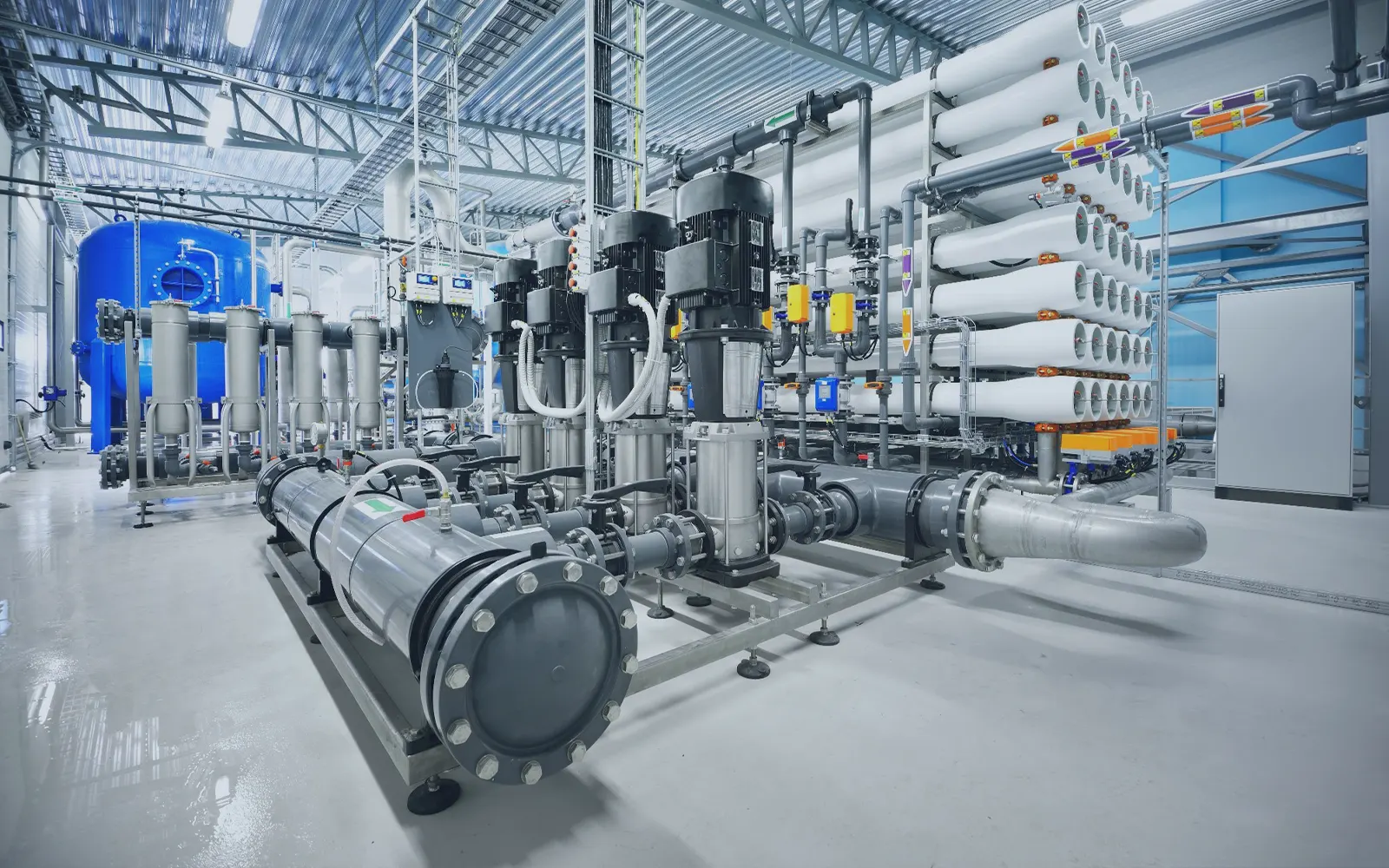
Modern industrial wastewater treatment plants rely on a carefully planned sequence of processes: physical, chemical and biological, possibly complemented by advanced technologies for dissolved salts and metals. It always starts with a protection stage: screens, grit chambers and primary sedimentation to reduce suspended solids and protect the pumps.
The chemical stage comes in when needed. Coagulation, flocculation and heavy-metal precipitation reduce dissolved loads and improve the water’s suitability for biological treatment. For dyes and complex compounds, advanced oxidation with O3/UV or H2O2/UV breaks down hard-to-treat molecules.
Then comes the heart of the process: biology. If COD is very high, the design moves to an anaerobic route that captures energy as biogas and produces roughly 6 to 8 times less sludge than aerobic systems. For medium-strength industrial wastewater, aeration or membrane bioreactors (MBR) achieve high removal, typically 80–90% of BOD and COD.
Where high-quality reuse is required, the chain is completed with nanofiltration membranes or reverse osmosis (RO) to reduce salts and ions. Here the treated water becomes a dependable resource for cooling, washing and some practical uses.
What do you actually gain from a well-built industrial wastewater treatment plant?
An industrial wastewater treatment plant is not a black box. It is an integrated economic, environmental and operational system, and its success is measured on the ground in numbers, not promises.
- Lower pollutant loads: removal of 80–95% of organic pollutants in suitable designs; heavy metals treated with efficiency above 80% through controlled chemical precipitation.
- Resource recovery: reuse of 50–90% of water inside the factory, depending on the required quality and membrane options.
- Potential added energy: the ability to convert organic matter in anaerobic systems into biogas that can be used for heat or electricity.
- Secure regulatory compliance: consistent conformity with BOD, COD, oil and metal limits to avoid warnings and fines.
One well-known example: an industrial wastewater treatment plant at a beverage bottling factory removed 215 tons of BOD per year and cut monthly expenses by about 23% after optimizing the biological stage and improving operating efficiency. This example is not an exception but a pattern that can be achieved with careful design and good monitoring.
Features and benefits designed for the decision-maker and the end user
The plant manager wants to hear the language of numbers, and the operator wants to feel how easy the plant is to run. When we combine the two, the industrial wastewater treatment plant becomes part of a reliable production system.
After reviewing operating data and failure patterns across many factories, the following package of gains is the one most often delivered by an industrial wastewater treatment plant:
- Stable and flexible operation
- A tangible reduction in chemicals and fresh water
- Water quality that allows reuse
- A better reputation with the community and regulators
There are also detailed gains from an industrial wastewater treatment plant that make a difference to the daily budget:
- Sludge cost: sludge production is 6–8 times lower in anaerobic systems than in aerobic ones, which means less disposal and lower cost.
- Energy: part of the electrical load is offset through biogas or smart aeration optimization, which directly lowers the energy bill.
- Chemicals: automatic dosing control saves 10–20% of reagent consumption on average while keeping quality stable.
- Footprint: compact MBR and MBBR solutions cut the required area by up to 40–60% compared with conventional basins.
A practical guide to choosing the right industrial wastewater treatment plant
The right choice starts with accurate data, not preconceived technical preferences. The water decides, and the technology serves.
The first step is to study the industrial wastewater: daily flow and peak averages, COD, BOD, TSS, oils and grease, metals, temperature and salinity. The second step is to define the quality target: compliant discharge, reuse for floor washing, cooling-water quality, or near-pure water.
Then balance CAPEX against OPEX. Chemical precipitation systems may be cheaper to build but heavier to run because of reagents and sludge, while advanced biological reactors raise the initial investment but recover the difference through lower operating costs.
In addition, space and infrastructure are decisive factors. Limited space usually points you to a compact membrane or anaerobic granular industrial wastewater treatment plant, while generous space allows conventional basins with lower CAPEX.
A table matching the technology to the type of industrial wastewater
A brief table that makes it easier to choose a technical direction before getting into design details.
| Discharge scenario | Typical indicators | Likely technology | Design notes |
|---|---|---|---|
| Very high organic load | COD > 4000 mg/L | Anaerobic reactor + aerobic polishing | Biogas recovery, less sludge |
| Medium/low organic load | COD < 1000 mg/L | Activated sludge or MBR | High final quality for reuse |
| Heavy metals | High Pb, Cr, Cu | Chemical precipitation + ion exchange | Safe sludge management is essential |
| Oils and grease | High O&G | Mechanical separation + flotation | Precedes biological treatment |
| High salinity | High TDS | Nano/RO | For sensitive applications and reuse |
| Dyes/complex compounds | Partially oxidized COD | Advanced oxidation + biological | Partial breakdown, then biological removal |
This table is no substitute for a small pilot test, but it shortens the path and reduces risk.
Feasibility calculations: numbers without surprises
A good financial model starts with a baseline: what are you paying now? Fresh water, pumping and aeration energy, reagents, sludge disposal, and discharge fees and potential fines. Then you compare that with what is expected after the plant.
These numerical ranges recur in the field:
- BOD/COD removal of 80–95% when the technology matches the load.
- A 30–70% reduction in fresh water consumption when internal reuse is adopted.
- Energy recovery from biogas covering 5–20% of heating or backup electricity loads in anaerobic systems.
And when does the payback period become clear? In mid-sized projects it ranges from 2 to 4 years when water and energy savings and avoided fines are counted. Where fines are high or water prices are steep, it can drop to under two years.
The role of compliance in protecting the license and the budget
Local regulations do not tolerate repeated violations. Limits differ from one country to another, but monitoring patterns have become more precise, including real-time measurement of some indicators and linking outlets to smart municipal systems.
Compliance does not just mean avoiding a violation. Stable compliance protects the operating license, eases customer audits, and raises sustainability rating scores. In the export sector, it may even be a condition for new contracts.
Most importantly, integrating online meters for pH, DO, ORP and TSS with a simple control system in the industrial wastewater treatment plant reduces performance fluctuations. A small investment in measurement can save a great deal in chemicals and energy.
Reuse: water that circulates inside the factory
Reusing industrial wastewater is not a luxury. At sites under pressure on water resources, an industrial wastewater treatment plant gives the factory a measure of water independence. Treated water of suitable quality can be directed to cooling, washing, industrial irrigation and even toilet flushing.
Field applications have shown that 90–95% of treated industrial wastewater can be pumped back internally when membrane technologies are integrated. The result is not only a lower fresh-water bill, but also less load on the public sewer network and a smaller water footprint for the factory.
The quality of the solution depends on managing sediments and chemicals carefully so that the reused water is free of impurities that disturb sensitive processes. That is why final polishing treatment with filtration and activated carbon is used in precision applications.
How is a successful industrial wastewater treatment plant implemented step by step?
Before any equipment is supplied, planning comes first. Good design reduces later modifications and ensures a smooth start-up.
- Diagnosing the operating data
- A small-scale pilot test
- Detailed design with peak scenarios
- An operation, maintenance and training plan
A pilot test on real water from the production line reveals what chemical analyses alone cannot: how the pollutants respond, dosing performance, foaming and odor behavior, and stability during peaks. Two to four weeks is enough to derive the design curves.
Questions to ask the supplier
Before the final contract, precise questions spare you future surprises and improve the contract terms.
- Guaranteed performance limits: What values are guaranteed at the outlet for BOD/COD/metals? And how are they measured?
- Energy and chemicals: What is the specific consumption in kWh/m³ and the expected reagent doses?
- Sludge: What daily quantity of wet and dry sludge is expected? And what is the disposal plan?
- Reuse: What water quality is achievable for each internal application? And what additional requirements apply?
- Expansion and maintenance: How is a new production line added? And what are the critical spare parts and their replacement intervals?
- Support and training: What follow-up package, site visits and operational emergency line are included?
These questions build a transparent relationship with the supplier and turn the contract into a successful operating partnership.
What about space and infrastructure?
Many factories suffer from limited space. Solutions exist. Compact MBR units, anaerobic granular reactors and advanced media filtration reduce the footprint. And smart infrastructure for piping, feed and aeration adds efficiency that is invisible on the drawing but tangible in operation.
Do not neglect odor management. Tank covers, local extraction and biofilters ease complaints and maintain a better working environment. It is an essential element at sites close to residential areas.
A transparent pricing model that makes the decision easier
To make the decision comfortable, you need a clear picture of the budget over the life of the industrial wastewater treatment plant. It is best to ask for an offer that includes the investment breakdown, a membrane/media replacement plan, and the expected energy and chemicals bill per cubic meter, along with sludge costs.
What sets advanced solutions apart today?
Smart control and real-time measurement have made the difference. Aeration systems based on demand control (DO control) cut energy by up to 20%. Sensor-based chemical dosing reduces consumption while keeping performance stable. And operating-data integrity standards have become part of some auditors’ requirements.
Biosecurity is also an important focus. Plans for managing microorganisms, programs to prevent unwanted biological tolerance, and odor monitoring all come together for a calm and continuous operating picture.
Why is now the right time to invest in an industrial wastewater treatment plant?
Fresh water costs are rising gradually, and enforcement is being applied more regularly. At the same time, technology advances have lowered CAPEX for some compact solutions and raised energy efficiency. The result is that the payback period is shorter than in the past, and the regulatory risk is higher for those who do not invest.
And as environmental disclosure grows in importance within corporate reporting, the success of an industrial wastewater treatment project directly affects non-financial performance indicators, opening doors to green financing and better credit terms.
How do we help you reach the most suitable industrial wastewater treatment plant?
We have a simple, practical approach. We start by reviewing your current data, run a pilot test on real samples, then present a detailed design with more than one cost scenario. We provide hands-on training for operators and monthly performance follow-up during the first year.
Because every factory is a special case, we suggest two options: a compact industrial wastewater treatment plant that is quick to install for time-pressed production lines, or a modular plant that can expand as the factory grows. Both come with clear performance indicators, a maintenance plan, and round-the-clock operational support.
If you want to recover part of the water for cooling or washing, we add a membrane polishing stage. And if your industrial wastewater is organic in strength, we integrate an anaerobic route that produces biogas covering part of your thermal loads.
Send us two weeks of discharge data, and we will come back to you with a technical and economic proposal that includes CAPEX, OPEX, water and energy saving scenarios, and the expected payback period. One step brings your factory closer to more efficient operation, lower cost and consistent compliance with standards.
What sets water treatment plants from Alpha apart:
- 13 years of experience in designing and building plants for diverse water sources, with technical site inspections and comprehensive risk analysis.
- A professional team of top engineers and experts in water desalination plants
- Partnerships with trusted brands to supply pumps, media and measuring instruments with manufacturer certificates and warranties.
- Fast execution and after-sales warranty with Site Commissioning, an extended warranty and rapid field response.
- Technical support and maintenance services through preventive maintenance contracts, 24/7 emergency support, and training the client’s team on operation and chemical cleaning of membranes.
Contact us now
- Call us and get a free consultation
- Or message us on WhatsApp and request a free quote
- Or send your project details by email: