
Article contents
RO Water Desalination Plants for Factories
Introduction
Modern industry depends fundamentally on a stable, reliable water source. Any interruption in the water supply, or even fluctuation in its quality, can halt production, shorten equipment life and raise operating costs. That is why investing in an RO water desalination plant for factories is no longer a secondary option; it has become a strategic necessity for any factory that wants to cut costs, improve product quality and secure a steady water source for the long term.
Factories today operate in an environment full of water-related challenges, such as scarce sources, poor water quality and rising utility costs. Whether a factory relies on municipal water or well water, it often faces problems such as high salinity, increased turbidity, high hardness and biological contaminants. This is where a desalination plant based on reverse osmosis (Reverse Osmosis) comes in, providing a powerful and effective solution that ensures a continuous supply of pure water to meet the requirements of each industrial sector.
Common Water Problems in Industrial Facilities
- Poor raw water quality: contains high levels of total dissolved solids (TDS), turbidity, chlorine, bacteria or heavy metals.
- Unstable supply: any sudden water cut can lead to a production stoppage.
- High transport and storage costs: buying water or trucking it in by tanker multiplies operating costs.
- Scaling and corrosion in equipment: salts and hardness cause scale to build up inside boilers, heat exchangers and cooling towers.
- Health and quality requirements: the food, beverage and pharmaceutical sectors require water that meets strict international standards.
Why Is an RO Water Desalination Plant for Factories the Best Solution?
- High purification efficiency: RO removes up to 99% of dissolved salts, as well as organic matter and most microorganisms.
- Great capacity flexibility: ranges from small units up to large water desalination plants.
- Lower operating costs: compared with buying water, an RO water desalination plant for factories saves a great deal in the long run.
- Higher production efficiency: stable, pure water helps improve product quality and reduce reject rates.
- Easy integration: it can be combined with multimedia filters, carbon filters, UV systems or ion exchange to meet the required standards.
Industrial Sectors: Water Uses and Required Specifications
| Industrial sector | Water uses | Required specifications |
| Food industry | Washing raw materials – processing – boilers – sterilization | TDS below 200–500 ppm, turbidity < 1 NTU, bacteria = 0, hardness < 5 ppm for boilers |
| Pharmaceutical sector | Water for injection – production processes – CIP systems | Conductivity < 1–5 µS/cm, bacteria = 0 (USP standards), endotoxins within limits |
| Bottled drinking water | Drinking water – filling lines | TDS below 150 ppm – acceptable taste and odor – bacteria = 0 |
| Petrochemicals | Cooling towers – boilers – material processing | TDS for cooling towers: 1000–2000 ppm, low hardness, silica for boilers < 20 ppm |
| Power plants | High-pressure boilers – cooling water | Conductivity < 0.2–1 µS/cm, silica < 10–20 ppb, low TOC |
| Textiles | Dyeing – washing – general operations | TDS below 150–250 ppm, turbidity < 1 NTU |
| Paper industry | Pulp – washing – processing | Low turbidity, TDS usually < 500 ppm, free of heavy metals |
| Beverages and juices | Blending – washing – boilers | TDS < 100–150 ppm, bacteria = 0, hardness < 5 ppm |
| Metal processing | Cooling – cleaning – surface treatment | TDS for cooling up to 2000 ppm, free of oils and grease, controlled pH |
| Electronics | UPW – component cleaning | Resistivity 18.2 MΩ·cm, silica < 1 ppb, TOC < 5 ppb |
| Plastics | Cooling – general processes | TDS < 500 ppm, balanced, scale-resistant chemistry |
| Fish farms (RAS) | Tank water – make-up water | Ammonia = 0, nitrite/nitrate under control, TDS depends on the fish species |
| Poultry and livestock farms | Drinking water – cleaning | Nitrate < 50 mg/L, bacteria = 0, TDS preferably < 500 ppm |
Standard Components of an RO Water Desalination Plant for Factories
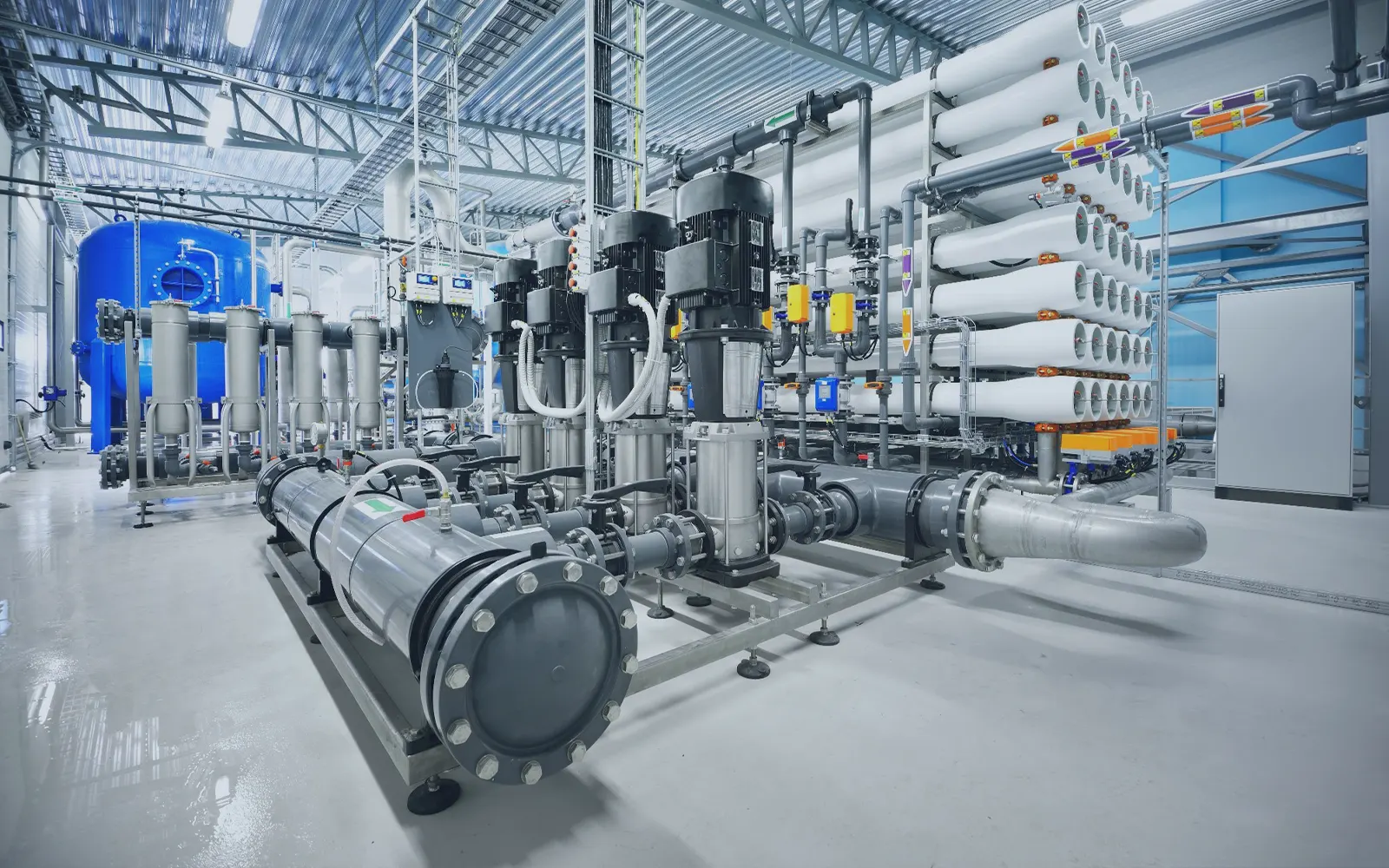
- Multimedia filters (sand/carbon) to remove turbidity and chlorine.
- 1–5 micron cartridge filters to protect the membranes.
- High-pressure pumps.
- RO membrane vessels and membranes (with recovery rates of 50–85% depending on water quality).
- CIP systems and backwash units.
- Product water tank and distribution pumps.
RO Water Desalination Plant for Factories: Suggested Capacity Ranges
- Small factories: 1–10 m³/day
- Medium industries: 10–50 m³/day
- Large factories: 50–500 m³/day
- Mega projects / industrial complexes: 500 m³/day and above
Water Consumption Rates by Industry
- Beverage factories: 0.5–3 m³ per ton of product
- Paper and chemical industries: 10–50 m³ per ton
What Sets the RO Water Desalination Plant for Factories from Alpha Apart:
- 13 years of experience designing and building plants for a variety of water sources, with technical site surveys and comprehensive risk analysis.
- A professional team of elite engineers and experts in water desalination plants.
- Partnerships with trusted brands for supplying membranes, pumps and measuring instruments, with manufacturer certificates and warranties.
- Fast execution and after-sales guarantee with on-site commissioning (Site Commissioning), an extended warranty and rapid field response.
- Technical support and maintenance services through preventive maintenance contracts, 24/7 emergency support, and training for the client’s team on operation and chemical cleaning of membranes.
Conclusion
If you are thinking of investing in an RO water desalination plant for factories, the right time to take that step is now. A professionally designed plant will help you achieve operational stability, reduce production costs and guarantee the water quality your industry needs to succeed.
Request a Free Consultation Now
Our team at Alpha is ready to design a water desalination plant suited to your case. Send us the project location, a recent water analysis if available, and the required capacity, and we will propose:
- A preliminary technical proposal.
- Actionable recommendations with a clear timeline.
- A detailed quotation within 24 hours, including a specified equipment list, a process flow diagram (PFD), CapEx and OpEx estimates, and warranty, maintenance and expansion options.