
Article contents
Water Desalination Plant for Poultry Farms: Importance and Types

Introduction
Water on a poultry farm is not just something to drink; it is one of the most important production inputs. Poor water quality raises consumption, wets the litter, increases heat stress, and disrupts vaccines and medications. In many parts of Egypt, poultry farm owners rely on salty well water, on a public network that suffers from outages and surges of rust, or even on mobile tankers whose water quality cannot be trusted.
The water contains a high level of salinity reaching 2000 or 3000 parts per million (ppm), in addition to hardness, iron and bacteria. On top of that, the summer heat in the Delta and Upper Egypt raises the birds’ water consumption. This is where a practical, measurable solution stands out: a water desalination plant designed specifically for poultry farms, using reverse osmosis (RO) technology, which helps improve production performance, cut water costs and increase environmental stability inside the poultry house.
Why does water quality fluctuate on poultry farms?
There are many factors: soil type, how close the well is to cultivated land, and the quality of the distribution network. And because poultry are more sensitive than humans to certain ions and microbes, the level that is acceptable for people is not a sufficient reference for the flock, and the difference shows up in the finest details.
The following table summarizes a common picture in rural Egypt, with recommended limits for poultry and the effects of exceeding them:
| Contaminant | Common source | Typical values in rural wells (mg/L) | Recommended limit for poultry (mg/L) | Effect on the flock |
|---|---|---|---|---|
| Total dissolved solids (TDS) | Partially saline groundwater | 800 to 3000 | Less than 1000 | Excess thirst, wet litter, poorer feed conversion ratio |
| Sodium/chloride | Salt layers, seepage of old water | 200 to 1200 | Chloride less than 250 | Bitter taste, reduced intake, thirst stress |
| Sulfates (SO4) | Gypsum rocks | 200 to 800 | Less than 250 | Diarrhea, especially in chicks; high humidity |
| Nitrates (NO3) | Fertilizers, sewage | 30 to 150 | Less than 50 | General stress, digestive sensitivity |
| Hardness (Ca/Mg) | Limestone layers | 200 to 900 as calcium carbonate | 60 to 180 after treatment | Scale deposits on nipples and water heaters |
| Iron | Dissolved iron in groundwater | 0.5 to 3 | Less than 0.3 | Clogged filters, growth of iron bacteria |
| Manganese | Specific geological formations | 0.1 to 0.8 | Less than 0.05 | Discoloration, unacceptable taste |
| Coliform bacteria | Open tanks, contaminated lines | Appear intermittently | Zero/100 mL | Health risks, reduced vaccine effectiveness |
| pH | Alkaline or acidic soil | 6.0 to 8.9 | 6.5 to 7.8 | Impaired absorption, corrosion or scaling inside the lines |
A water desalination plant for poultry farms: an effective solution whose success is measured in numbers
Reverse osmosis (RO) technology separates more than 97% of dissolved salts, with high removal of nitrates, sulfates, iron and manganese after pre-oxidation. The result is water with consistent specifications, a clean drinking line, and tighter control over drinking and medication programs.
A desalination plant designed specifically for a poultry farm differs from a general-purpose desalination plant. The goal here is not just to produce ultra-pure water for human drinking, but balanced water for poultry that improves intake and reduces wet litter.
Features and benefits of installing a water desalination plant for poultry farms
The improvement shows not only in laboratory tests but in the daily life of the poultry house: dry litter, drinking lines that do not scale up, a consistent taste, and easier vaccine dosing.
- Improved production performance: mortality in the first two weeks falls by 0.3 to 0.8 percentage points, and the feed conversion ratio improves by 0.05 to 0.12 points when salinity and nitrates are controlled.
- Lower water cost: after the investment, the cost of producing a cubic meter is 4 to 9 EGP for energy, chemicals and filters, compared with tanker water that can exceed 20 to 40 EGP per meter.
- Environmental stability inside the poultry house: litter moisture drops by 5 to 10 relative percentage points in hot periods thanks to better taste and controlled drinking rates.
- Reliable vaccines and medications: water with low hardness and iron reduces reactions with active ingredients and ensures the dose gets through.
- Easier maintenance: the absence of deposits extends the life of nipples, valves and check valves, and reduces line downtime.
- Digital quality control: logging of conductivity, pH, free chlorine and indicator bacteria, which supports the biosecurity system.
A realistic numerical example showing the return
A farm of 20,000 birds, one cycle. If the feed conversion ratio improves by 0.08, with average feed consumption of 3.2 kg per bird, that saves about 5,120 kg of feed per cycle. At an approximate price of 14,000 EGP per ton, feed savings alone come to roughly 71,000 EGP per cycle. The operating costs of a 15 m³/day plant, including energy and chemicals, are usually far below this figure per month. And most importantly, performance becomes consistent between summer and winter cycles.
Components of a water desalination plant for poultry farms
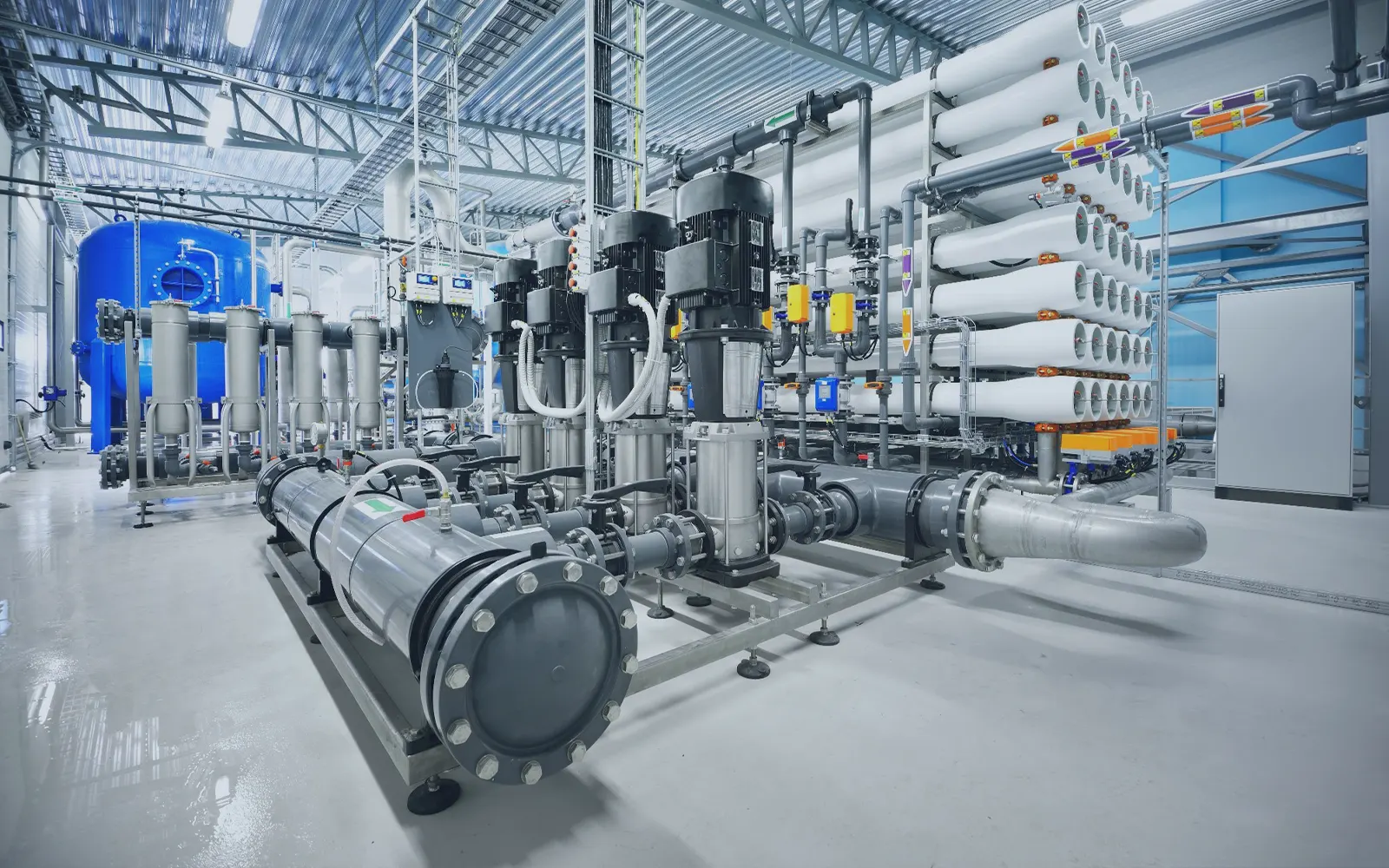
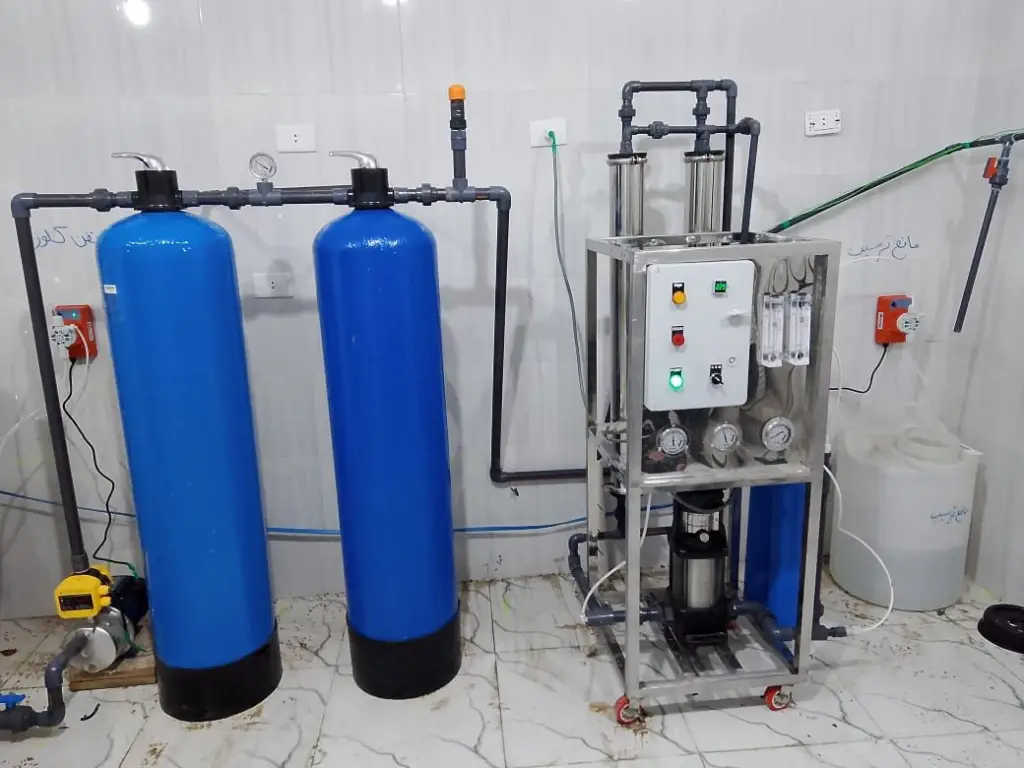
These components are installed according to your water analysis, to balance performance and cost together. Below are the main components:
- Multi-media sand filter to remove turbidity
- Carbon filter to reduce chlorine and organic matter
- Antiscalant dosing system
- 5-micron cartridge filter to protect the membranes
- Energy-saving high-pressure pump
- RO membranes
- Disinfection with ultraviolet light or controlled chlorine
- Electrical operation and control panel
Capacity, energy and expected costs
Capacity calculation starts from the birds’ own consumption. Consumption is affected by age, temperature and breed. Practical capacities for poultry farms start at 5 to 20 m³/day for small and medium farms, and reach 50 or 100 m³ for large multi-house projects.
The following table helps estimate the capacity the farm needs:
|
Number of birds per cycle |
Average daily consumption | Suggested plant capacity | |
|---|---|---|---|
| 5,000 birds | 2 m³ | 1 m³/hour | |
| 10,000 birds | 4 m³ | 2 m³/hour | |
| 20,000 birds | 8 m³ | 4 m³/hour | |
| 40,000 birds | 16 m³ |
8 m³/hour |
The values include a daily cleaning margin; during heat waves, raise the capacity by 20% to stay on the safe side.
💡 Tip: Request a free consultation from our team to determine the system best suited to your water source.
Controlling salinity and taste, and remineralization
Ultra-pure water is not the goal inside the poultry house. Poultry need water with a balanced taste and low corrosivity. Remineralization through calcite, or blending in a small proportion of raw feed water, raises alkalinity and total hardness to 80 to 120 mg/L as calcium carbonate and stabilizes pH between 7.2 and 7.8. This reduces the dissolution of metals from the pipes and improves the birds’ acceptance of the water.
The ratio can be controlled precisely with a blending valve or a dosing pump, with electrical conductivity (EC) monitored as a quick guide. When temperatures are high, it is advisable to keep total salinity around 400 to 800 ppm to ensure an acceptable taste without increasing the salt load on the birds.
Integrating the plant with drinking lines and house management
Desalination is part of a larger system. It is preferable to use an elevated or ground tank that is closed with a tight cover and a sanitary inspection hatch, with continuous water circulation and gentle mixing to prevent stagnation. Disinfection is either with free chlorine at 0.2 to 0.5 mg/L in the tank, with residual measurement at the ends of the lines, or with ultraviolet light before the tank, with periodic cleaning of the tank itself.
The lines need automatic or manual flushing every few days, with steady pressure that does not cause spraying. All these procedures become easier with low-turbidity water free of the minerals that used to make maintenance heavier.
The impact on total production cost
Good water translates into saved kilograms of feed, fewer maintenance hours, and longer equipment life. Even the resulting manure is lighter because the litter does not carry excess water, which makes transport and handling easier.
When you calculate the total cost, you will find that small savings in feed conversion ratio, together with a slight drop in mortality, effectively pay for the desalination plant. And when you add the stability factor from one cycle to the next, the result of building a water desalination plant becomes clear on the profit scale.
Steps to implement a water desalination plant for poultry farms and the expected timeline
Implementing a water desalination plant for poultry farms begins with a technical site visit and sampling for raw water analysis: salts, metals, nitrates, sulfates, turbidity, microbiology. A technical design is then presented with clear capacities and stage arrangement.
Manufacturing and assembly usually take 2 to 4 weeks depending on capacity and component availability. On-site installation takes 3 to 5 days, followed by a trial run and training for the farm team on daily operation, periodic flushing and quick tests.
A water desalination plant for poultry farms: why now?
Competition is high, and margins are tightening in closely spaced cycles. Stable water adds confidence to your management and your sales plans. If your farm suffers from salinity, scale deposits, or fluctuating taste and palatability, installing a water desalination plant for poultry farms is worth trying.
What sets the water desalination plant for poultry farms from Alpha apart:
- 13 years of experience in designing and building plants for diverse water sources, with technical site inspections and comprehensive risk analysis.
- A professional team of top engineers and experts in water desalination plants
- Partnerships with trusted brands to supply membranes, pumps and measuring instruments with manufacturer certificates and warranties.
- Fast execution and after-sales warranty with Site Commissioning, an extended warranty and rapid field response.
- Technical support and maintenance services through preventive maintenance contracts, 24/7 emergency support, and training the client’s team on operation and chemical cleaning of membranes.
Practical steps to price your project accurately
- Carry out a complete water analysis (TDS, turbidity, SDI, silica, iron, manganese, bacteria).
- Define the daily operating hours and peak limits.
- Agree on the water quality required for each use on site.
- Review the intake and discharge routes and calculate energy consumption costs.
- Request a detailed offer that states the components, brands, warranty, maintenance plan and annual operating cost.
Contact us now
- Call us and get a free consultation
- Or message us on WhatsApp and request a free quote
- Or send your project details by email: