
Article contents
Groundwater Well Desalination Plant: A Complete Guide

Introduction
Groundwater from wells is a real treasure, but it is not always suitable for drinking or direct use. Much of the well water in villages, farms, resorts and industrial areas shows salinity and dissolved solids that exceed health standard limits. This is where a carefully designed well water desalination plant proves its value, giving you water of consistent quality, with an acceptable taste and well-planned operating costs.
Why Do We Install a Well Water Desalination Plant?
Groundwater from wells can carry total dissolved solids ranging from 1,500 up to 10,000 parts per million, and in some areas up to 25,000 parts per million. These figures mean high water hardness, limescale deposits and an unpleasant taste. In quite a few cases we also find iron, manganese and hydrogen sulfide, which cause a rotten-egg smell and change the color of the water.
A well water desalination plant ensures consistent water quality whether in the dry season or after rainfall. More importantly, it gives you full control over taste, color, odor and safety indicators.
How Does a Well Water Desalination Plant Work with Reverse Osmosis (RO) Technology?
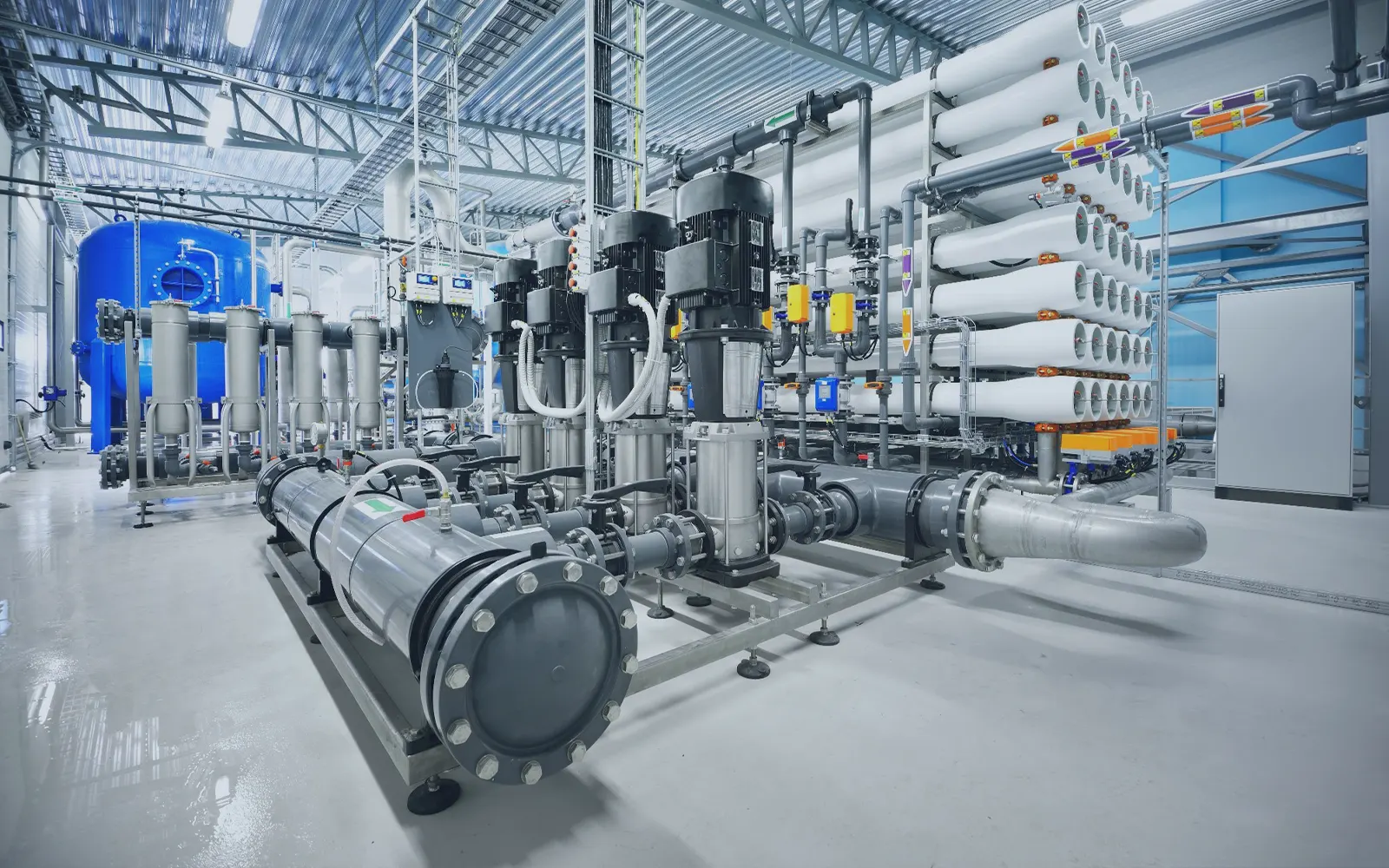
Reverse osmosis for brackish well water works by pushing the well water through semi-permeable membranes under high pressure. The main steps in well water desalination begin with initial filtration, then anti-scalant injection, then the reverse osmosis (RO) unit, and finally disinfection.
- The operating pressure for brackish well water is usually between 10 and 20 bar.
- The recovery rate for well water ranges between 50 and 85 percent, depending on salinity and the quality of pretreatment.
- The salt removal efficiency for well water reaches 98 to 99.5 percent with modern membranes.
- Practical electricity consumption is often between 0.8 and 2.5 kWh per cubic meter for brackish water, and may be lower with energy recovery units.
The Main Stages of the Process
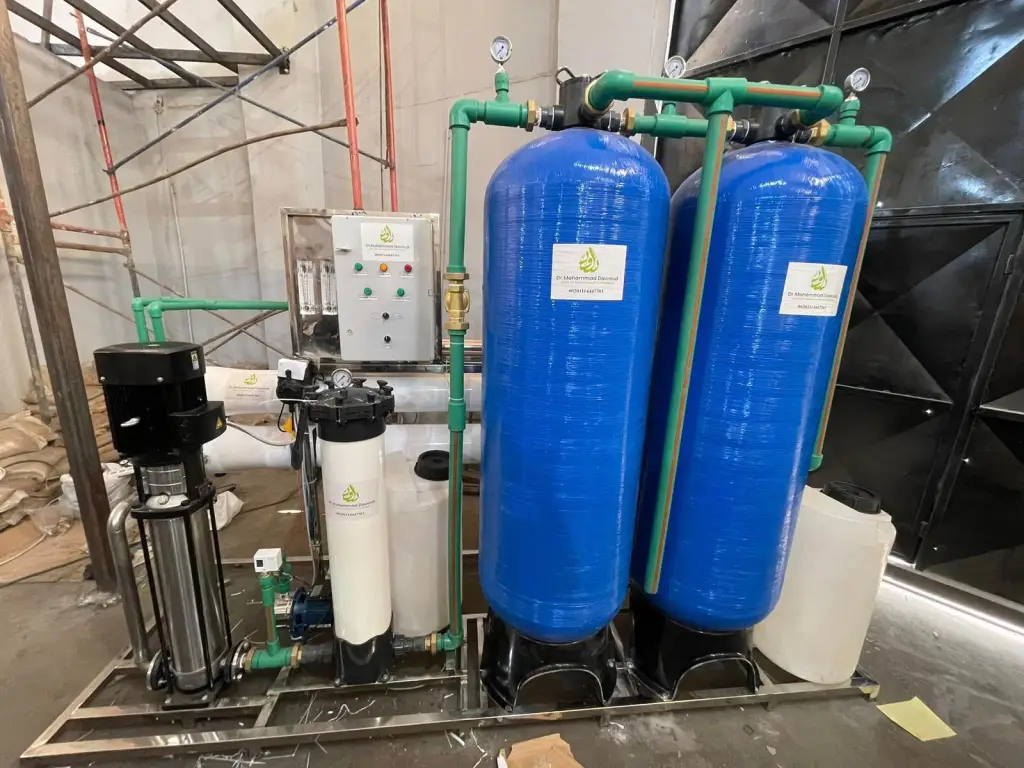
- Pretreatment: Sand and carbon (media) filters, cartridge (micron) filters, and an anti-scalant system.
- Main unit: RO membranes inside pressure vessels (housings) with high-pressure pumps.
- Measurement and control: Manual/automatic operation and monitoring of the plant’s parts and components.
- Post-treatment: Final disinfection (chlorine/ultraviolet UV).
The goal is to protect the membranes and reduce their replacement while maintaining water quality.
About the Well Water Desalination Plant
- Technology: Reverse osmosis (RO)
- Water source: Groundwater from wells
- Raw water salinity TDS: Ranges between 1,500 and 25,000 PPM.
- Available production capacities: From 5 m3 / day to 10,000 m3 / day.
- Produced water specifications: Suitable for the required use (drinking, poultry and livestock farming, irrigation, etc.).
- Sectors served by the well water desalination plant:
- Coastal sector: hotels and tourist resorts – power generation plants
- Livestock sector: poultry and cattle farms – fish farms
- Pharmaceutical sector: pharmaceutical and cosmetics factories – laboratories and labs
- Industrial sector: food, chemical, engineering and metal industries of all kinds, and more
- Medical sector: hospitals – dialysis centers
- Agricultural sector: farmland – nurseries – greenhouses
Well Water Analysis Before Any Design
Testing groundwater is not a formality. It is the basis of a correct design and of the plant’s lifespan. A sample that accurately represents the well, taken after continuous pumping for 20 to 30 minutes, gives us a realistic reading.
After an initial groundwater analysis, the path becomes clear: do we need oxidation to remove iron, catalytic filtration for manganese, or activated carbon for odor? Is an anti-scalant alone enough to handle sulfates and silica, or is prior softening by ion exchange required?
- Basic chemical parameters: TDS, conductivity, alkalinity, total hardness, calcium, magnesium, sodium, potassium.
- Elements requiring special treatment: Iron, manganese, ammonia, nitrate, fluoride, arsenic, barium, strontium.
- Operational indicators: SDI or MFI, turbidity, silica, hydrogen sulfide, pH.
Tips for Setting the Budget Accurately
- Define the required produced-water specifications precisely to avoid unnecessary expenses.
- Request quotations from companies and compare them based on components, brands and warranty, not price alone.
- Ask for a line item that breaks out the energy and annual operating cost.
What Sets Well Water Desalination Plants from Alpha Apart:
- 13 years of experience in designing and building plants for a variety of water sources, with technical inspections and comprehensive risk analysis.
- A professional team of elite engineers and experts in water desalination plants
- Partnerships with trusted brands for supplying membranes, pumps and measuring instruments with manufacturer certificates and warranties.
- Fast execution and after-sales warranty with Site Commissioning, an extended warranty and rapid field response.
- Technical support and maintenance services through preventive maintenance contracts, 24/7 emergency support, and training the client’s team on operation and chemical cleaning of the membranes.
Quick Questions to Help You Before Requesting a Quotation for a Well Water Desalination Plant
- What daily capacity do you actually need, including a growth margin?
- Do you have a recent water analysis from the last three months?
- What is your current power source? Are there plans for solar energy?
- What water quality is required: drinking, irrigation, industrial or medical?
- What is the site area, and what are the intake and discharge routes?
The answers to these questions speed up preparing an accurate offer the first time.
Contact Us Now
- Call us and get a free consultation
- Or message us on WhatsApp and request a free quotation
- Or send your project details by email: