

Article contents
Seawater Desalination Plants RO for Hotels and Tourist Villages

Introduction
Hotels and coastal villages depend on stable, high-quality water sources to ensure guest comfort and keep daily services running. With municipal water outages and quality fluctuations recurring, coastal RO seawater desalination plants have become the most effective and dependable solution for hotels and tourist villages.
This article explains the water challenges they face today, how coastal desalination plants provide the ideal solution, and presents data and figures to help you make the right purchasing decision.
First: Why Do Hotels and Tourist Villages Struggle with Water Supply?
Many hotels and tourist villages face daily problems that affect service levels and guest ratings, the most important of which are:
- Frequent interruptions of the municipal network water, which disrupt cleaning, kitchens, laundry and room services.
- Fluctuating water quality in terms of salinity, chlorine, turbidity and odors, which affects food safety and guest comfort.
- Weak water pressure and insufficient supply reaching the upper floors or distant units.
- High consumption during peak tourist seasons, when water demand can suddenly double.
- High logistics costs when relying on water tankers or bottled water.
- Equipment damage from using water with high salinity or hardness, causing deposits and corrosion.
- Negative impact on reputation when guests complain about water problems or outages.
These challenges are a heavy operational and financial burden, and can affect both a hotel’s ratings and its revenue.
Second: How Do Coastal RO Seawater Desalination Plants Provide the Ideal Solution for Hotels and Tourist Villages?
Coastal RO seawater desalination plants make it possible to produce fresh water directly from the sea at consistent quality, without depending on the municipal network. The key benefits are:
- Stable supply that is independent of any external outages.
- High water quality, with salts reduced from 35,000 ppm to less than 500 after the necessary treatment stages.
- Flexible, modular design that can be scaled up or down according to seasonal demand.
- Lower operating costs associated with transporting or buying water.
- Longer equipment life and fewer breakdowns thanks to low-salinity water.
- A better guest experience by providing clean water around the clock.
Facts and Figures You Should Know
When considering buying seawater desalination plants RO for hotels and tourist villages, it is important to know a few reference values:
- Seawater salinity: between 30,000 and 45,000 mg/L TDS.
- Product water salinity: often below 500 mg/L after final treatment.
- Recovery rate: usually between 30% and 50% depending on the site and water quality.
- Energy consumption:
- Without energy recovery devices (ERD): about 4–6 kWh/m³.
- With modern ERD systems: about 1.5–3.5 kWh/m³.
- Membrane life: 2–3 years with good pretreatment.
- Brine concentration: usually 1.2 to 1.8 times higher than seawater salinity.
- Effective operating rate: can reach 92% or more in well-designed coastal RO seawater desalination plants.
Suitable Capacities for RO Seawater Desalination Plants for Hotels and Tourist Villages
Choosing the capacity depends on the number of rooms, swimming pools, restaurants, facilities and average occupancy. The following are indicative ranges:
- Small hotel or boutique resort: 5 – 50 m³/day
- Medium resort (100–200 rooms): 50 – 500 m³/day
- Large resort (200–800 rooms): 500 – 2,000 m³/day
- Mega tourism projects / tourist villages: 2,000 – 10,000+ m³/day
As a reminder, average consumption per guest ranges from 150–400 liters/day depending on the service level.
Plant Components and Treatment Systems
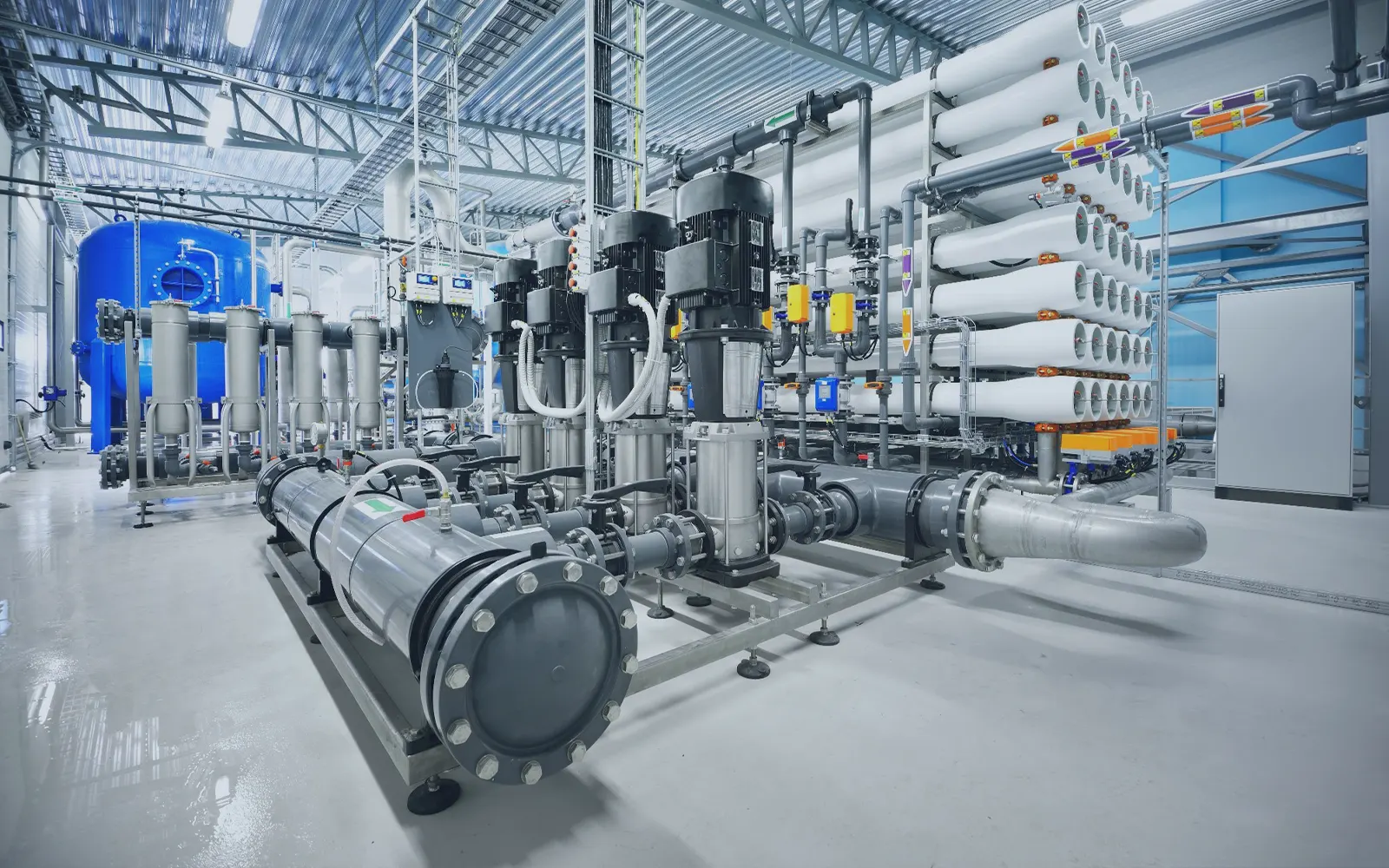
A seawater desalination plant is not just membranes, but a complete system that includes:
- Pretreatment: sand and multi-layer filters, cartridge filters, and chemical dosing systems.
- High-pressure unit and RO: the heart of the system, including the membranes and energy recovery systems.
- Post-treatment: pH adjustment, and disinfection with chlorine or UV.
- Storage, pumping and distribution: product water tanks, pumps and internal distribution networks.
- Environmental handling of brine: discharge systems that ensure compliance with environmental standards.
Economic and Operational Aspects of RO Seawater Desalination Plants for Hotels and Tourist Villages
- Capital costs (CAPEX): vary according to capacity and components. Roughly:
- Small plants (10–50 m³/day): tens of thousands of dollars.
- Medium plants (100–500 m³/day): hundreds of thousands of dollars (lower range).
- Large plants (1000+ m³/day): from hundreds of thousands to millions of dollars.
- Operating costs (OPEX): depend on energy, chemicals, maintenance, membranes and labor.
- Return on investment: comes from reducing the cost of purchasing water and cutting down operational problems.
- Operation and maintenance: a trained technician is recommended, or a contract with a specialized company under an O&M arrangement.
Environmental and Regulatory Compliance for RO Seawater Desalination Plants for Hotels and Tourist Villages
To ensure sustainable operation:
- Brine management through mixing or dispersion systems (Diffusers).
- Reduced energy consumption by using ERD or integrating solar power.
- Continuous monitoring of water quality, pressure and salinity.
- Obtaining the required permits for water intake and discharge.
Quick Checklist Before Making a Decision
- Calculate the site’s actual daily consumption.
- Analyze the local seawater accurately.
- Choose a modular design that can be expanded.
- Include an energy recovery system to reduce operating costs.
- Plan brine discharge in line with local regulations.
- Allow a reserve margin (5–10%) for any future expansion.
Why Invest Now?
- Ensure water continuity without interruptions that affect guests.
- Lower long-term costs compared with buying and transporting water.
- Improve the overall impression and boost ratings on booking platforms.
- Achieve sustainability goals using energy-efficient desalination technologies.
Conclusion
For coastal hotels and resorts, seawater desalination plants RO are a strategic choice that gives you water independence, consistent water quality and tangible long-term financial savings.
Start with a preliminary study that includes an analysis of your daily consumption, the quality of the seawater, and the geographic location of the sea intake.
Keep the following ranges in mind when choosing the capacity:
- 5–50 m³/day (small facilities)
- 50–500 m³/day (medium resorts)
- 500–2,000 m³/day (large resorts)
- 2,000+ m³/day (tourist villages and mega projects)
What Sets the Coastal RO Seawater Desalination Plants from Alpha Apart:
- 13 years of experience designing and building plants for a variety of water sources, with technical site surveys and comprehensive risk analysis.
- A professional team of elite engineers and experts in water desalination plants.
- Partnerships with trusted brands for supplying membranes, pumps and measuring instruments, with manufacturer certificates and warranties.
- Fast execution and after-sales guarantee with on-site commissioning (Site Commissioning), an extended warranty and rapid field response.
- Technical support and maintenance services through preventive maintenance contracts, 24/7 emergency support, and training for the client’s team on operation and chemical cleaning of membranes.
Contact Us Now
- Call us and get a free consultation
- Or message us on WhatsApp and request a free quote
- Or send your project details by email: